


If you have been through NorthPark in the last two weeks, there is a decent chance you walked past two of ours.
Denago EV is one of nine dealerships in the NorthPark AutoShow 2026, which runs through Sunday, August 16. We brought a Glacier Rover XL and a Matte Black Nomad XL, parked on Level One outside Byredo, a short walk from the Bentleys and the McLarens. Regular mall hours. No ticket, no rope, just walk up.
That is the whole commercial.
Now look at the background of that photo. The red thing.
That is a Mark di Suvero. It is forty-eight feet tall, it weighs twelve tons, and it has been standing in that court since 2006. Thousands of people walk underneath it every day on their way to lunch without once looking up.
So while we have your attention: here is a short guide to what else is hiding in the building.
Why there is world-class art in a shopping mall
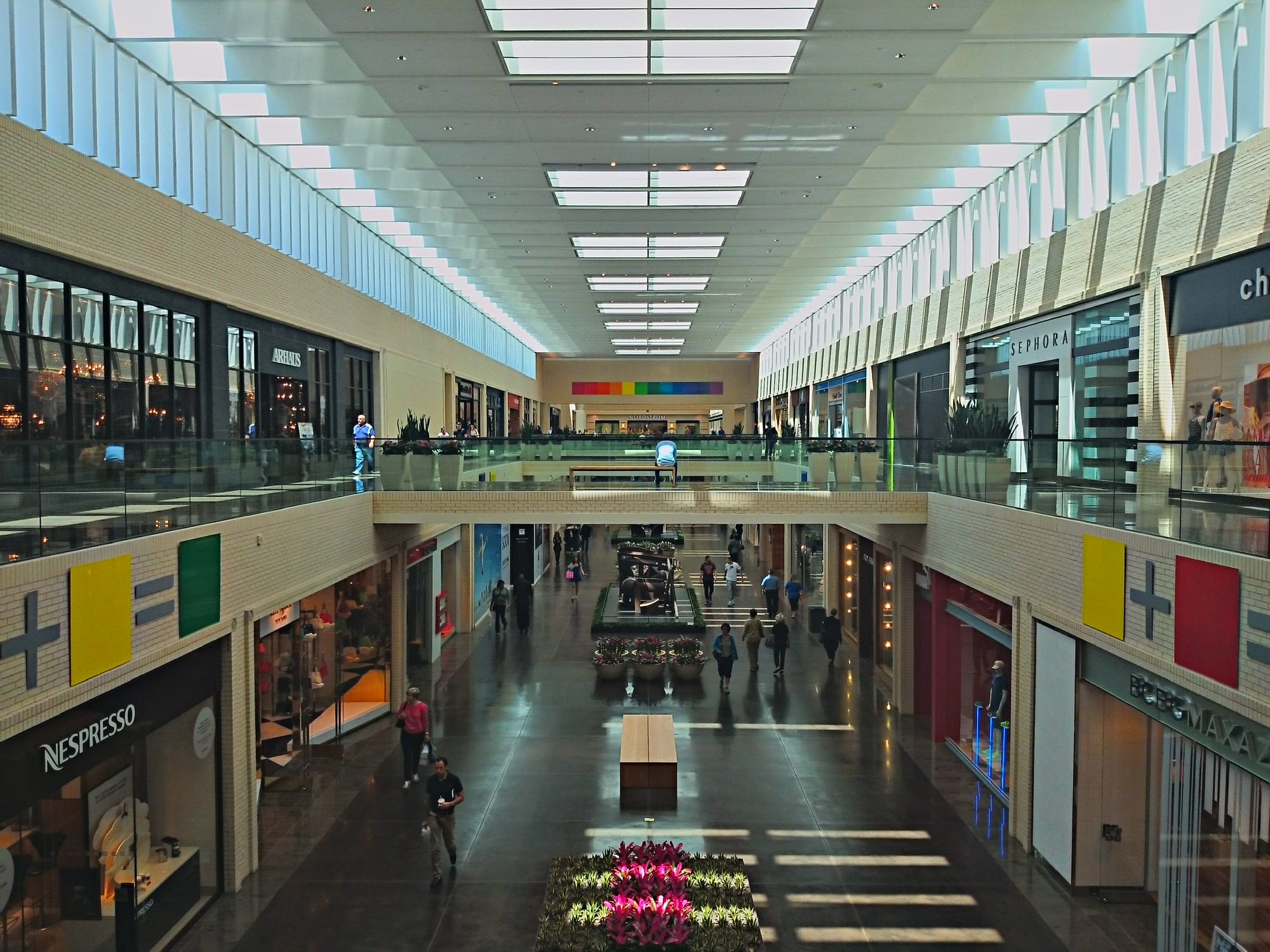
Short answer: a woman named Patsy Nasher.
She and her husband Ray opened NorthPark in 1965 on a leased cotton field five miles north of downtown. Art was not part of the plan. NorthPark’s own architect, E.G. Hamilton, was blunt about it: “When we designed the center, there was no mention of art.”
Then in 1967 Patsy walked into a New York gallery and bought a Jean Arp bronze as a birthday present for Ray. That was the first piece. She turned out to have one of the great eyes of her generation — she only bought things that gave her butterflies, and her own summary of the situation was “Ray and I are by art possessed.” By 1971 the sculpture had started moving into the mall.
Ray’s reasoning was about the people who would never buy a ticket to anything. His daughter Nancy, who owns NorthPark today, remembers him putting it this way:
“Maybe 90 percent of people will never go to a museum but maybe they’ll be inspired to learn more about art and study art, just by coming here.”
Sixty-one years later NorthPark draws around 26 million visits a year. When the sculptor Joel Shapiro was asked why on earth he would show work in a shopping mall, his answer — as Nancy Nasher tells it — was: “Where am I ever going to have 26 million people a year see my work?”
Almost none of it belongs to the mall, by the way. Nearly every piece is a long-term loan from the family’s private collection. And there are no ropes and no guards standing over any of it. The protection is landscaping, big plinths, and the assumption that you will behave.
The big red one: Mark di Suvero, Ad Astra
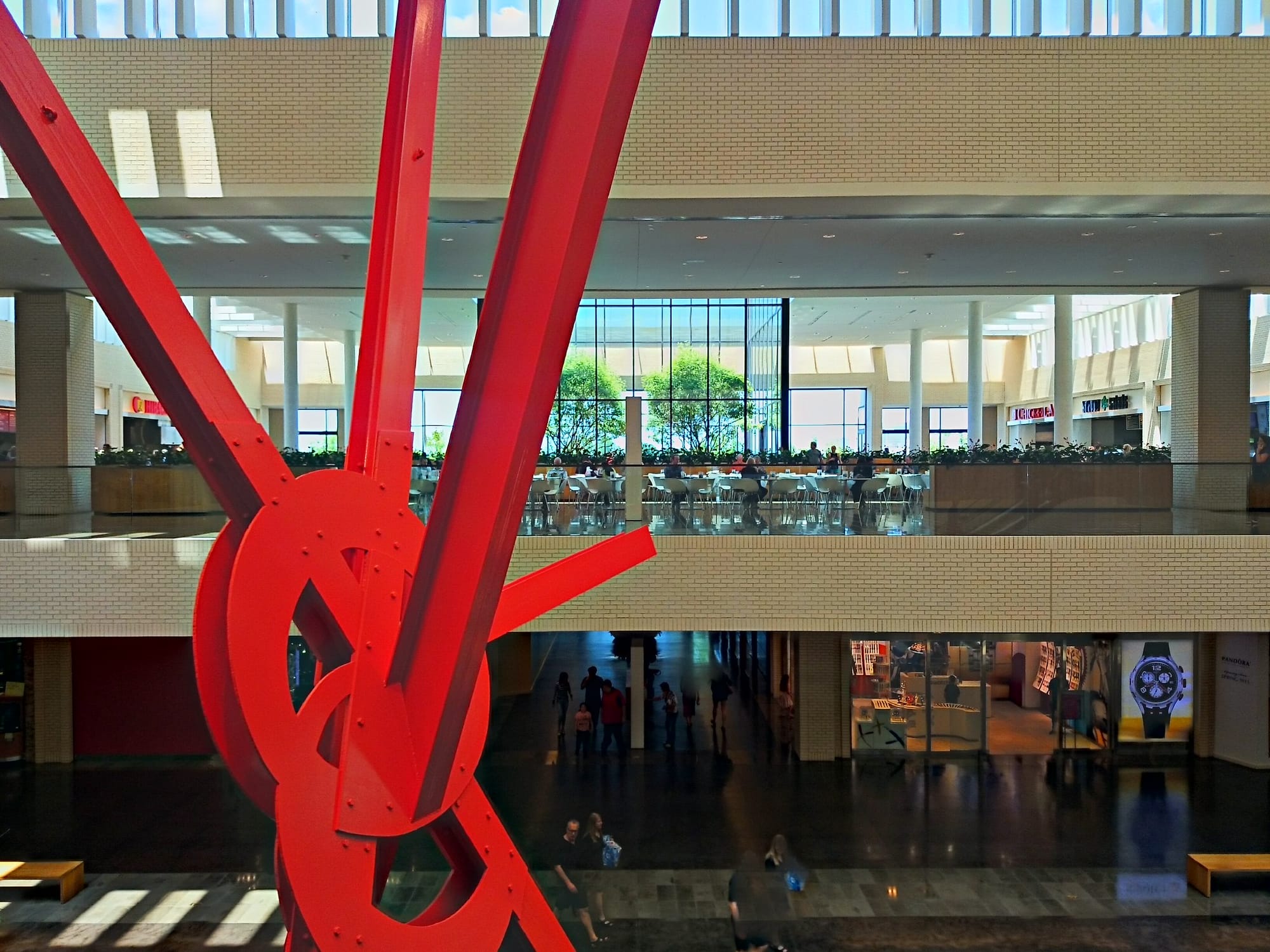
The title is Latin for to the stars. The story of how it got here is better than the title.
Di Suvero built it in California and installed it himself at Storm King, up the Hudson from New York City, in 2005. The New York Times ran a piece on the installation headlined “How to Install a 48-Foot, 12-Ton Orange Steel Giant.” Nancy Nasher read it in Dallas over breakfast.
“When I read about Ad Astra in The New York Times in 2005, my husband and I immediately flew to Storm King in New York to see it.”
A year later di Suvero was standing in this court, which did not have a roof on it yet, bolting it together. “He placed, by hand, every bolt and erected this sculpture,” Nasher has told tour groups.
Which is the thing to know about him. He was born in Shanghai in 1933. In March 1960 an elevator crushed him on a construction site and broke his back; doctors did not expect him to walk again. He learned to weld during his rehabilitation and has worked on crutches ever since. He builds without models, improvising with a crane, which he treats as a drawing instrument. He named his first one “For Love,” after a book of poems.
He is also the guy who, in 1966, hung a car off a protest sculpture in Los Angeles to prove to city inspectors that it would hold.
All of that is standing over an escalator, next to a café.
The ones that move: Jonathan Borofsky, Five Hammering Men
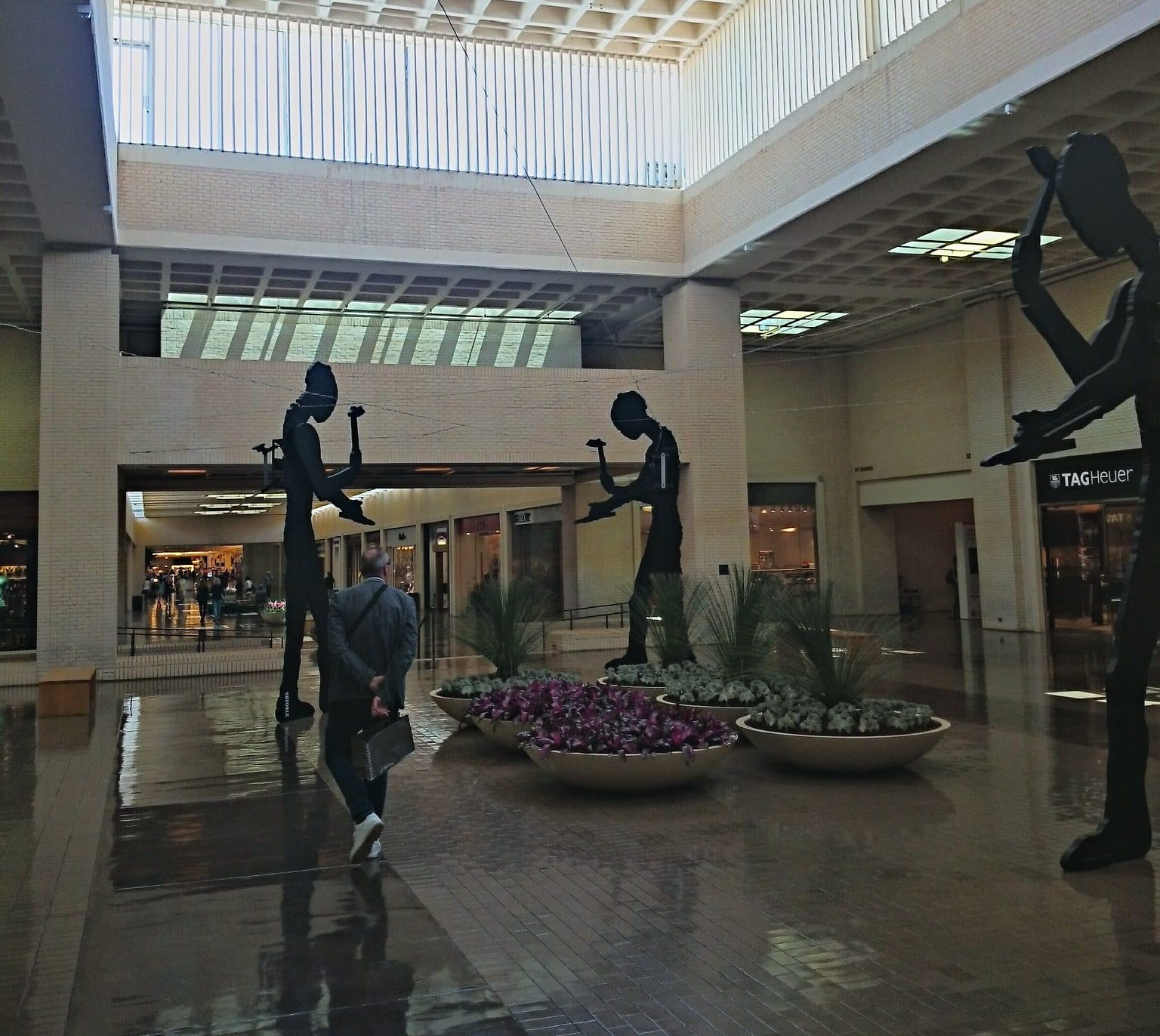
If you grew up in Dallas, this is probably the first sculpture you ever loved. Five black figures, each over fourteen feet tall, arms rising and falling on small electric motors, all day, forever.
Borofsky has installed Hammering Men in Seattle, Frankfurt, Basel, Seoul and Los Angeles, and the original idea was that they would all be swinging at once — “sort of a worldwide installation connecting us all together.” What they represent is not complicated:
“The Hammering Man is a symbol for the worker in all of us … I like to say, ‘between the mind and the hand, there is the heart.’”
One detail worth carrying around: at twenty-five, Borofsky started counting for three hours a day and writing the numbers in a sketchbook, and for years afterward he signed his work with numbers instead of his name. These are signed that way.
And here is the part almost nobody knows. The Hammering Men disappeared for nearly four years. They were damaged and removed in July 2021 and did not come back until February 2025. NorthPark never said what happened, who repaired them, or where they went. They just quietly took as long as it took and put them back.
Three artworks in one photograph
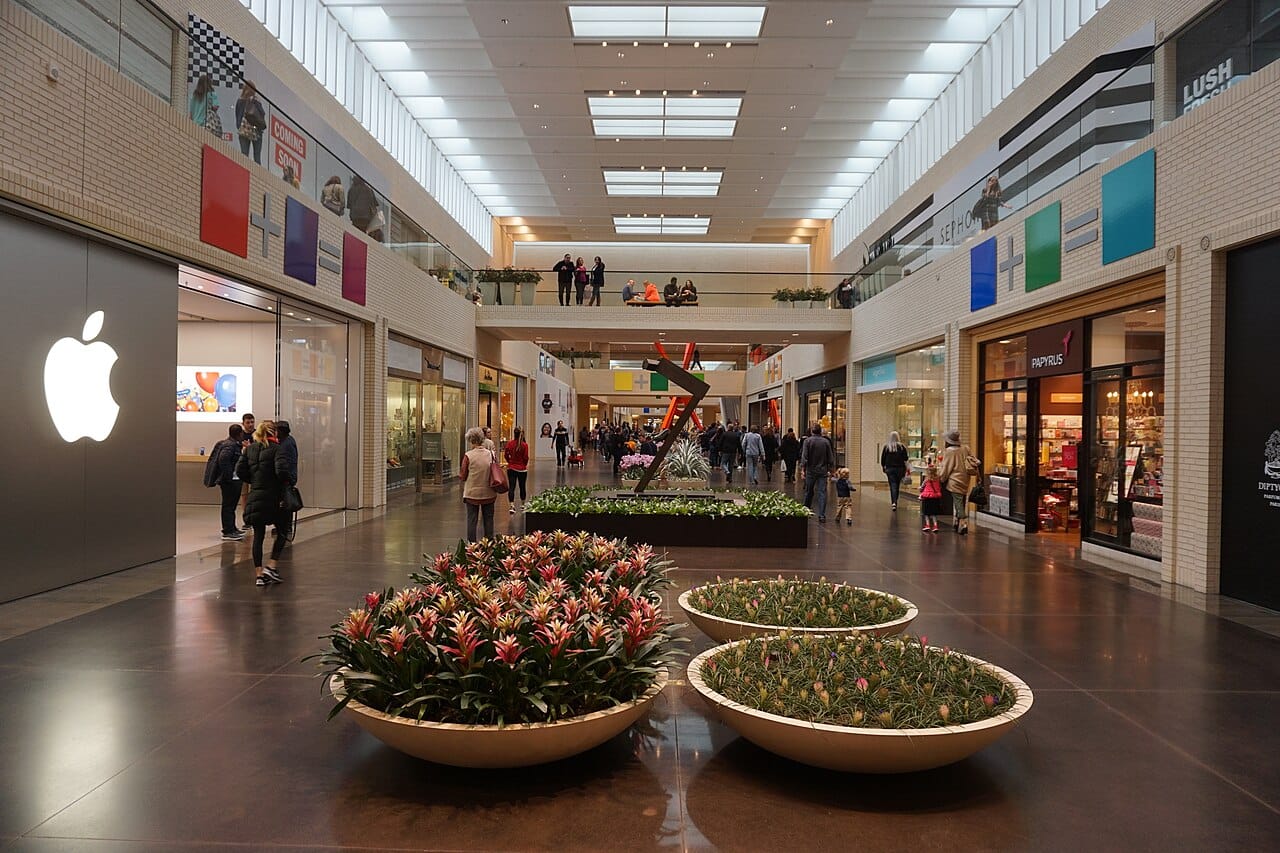
This is a photo of people buying phones, and it contains three works of art.
The rusted steel piece in the middle distance is an Anthony Caro, from a series he designed in his late eighties to run down the planted medians of Park Avenue in Manhattan. The funding never came together, so the sculptures became independent works and some of them came to Dallas. He built them to be read two ways at once — glimpsed at speed and studied slowly — which is more or less exactly how a mall corridor works.
Beyond it, that orange glow is Ad Astra again, down the concourse.
And the colored squares on both walls are the Color Equations panels. Blue plus yellow equals green. There are twenty-one of them scattered through the center, and most people have walked past all twenty-one without registering a single one.
Also, there are turtles
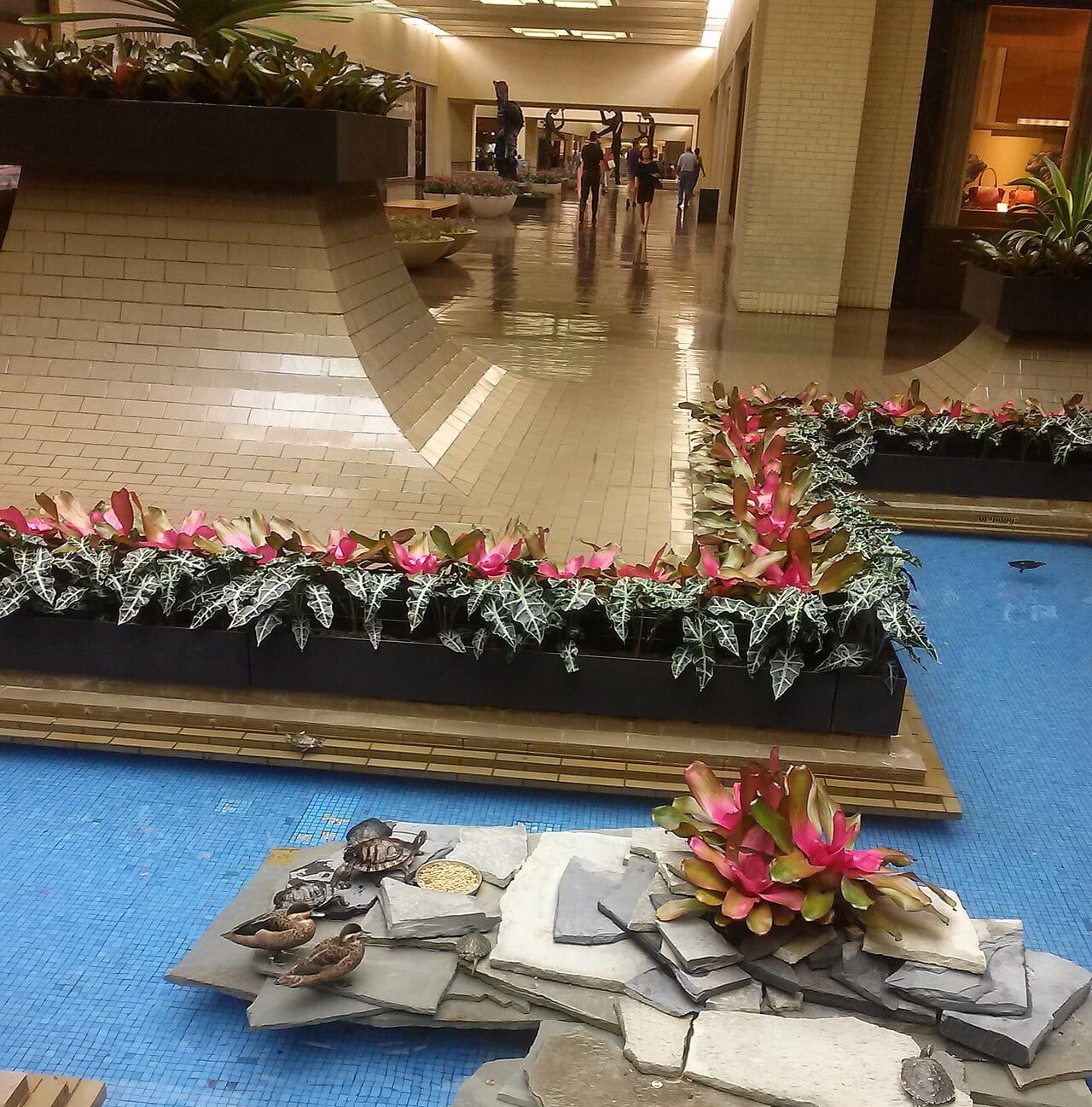
We feel this photograph explains NorthPark better than we can. Live turtles sunning themselves on a slate island, ducks paddling around, bromeliads, and several million dollars of contemporary sculpture down the hall.
Six things about NorthPark you probably did not know
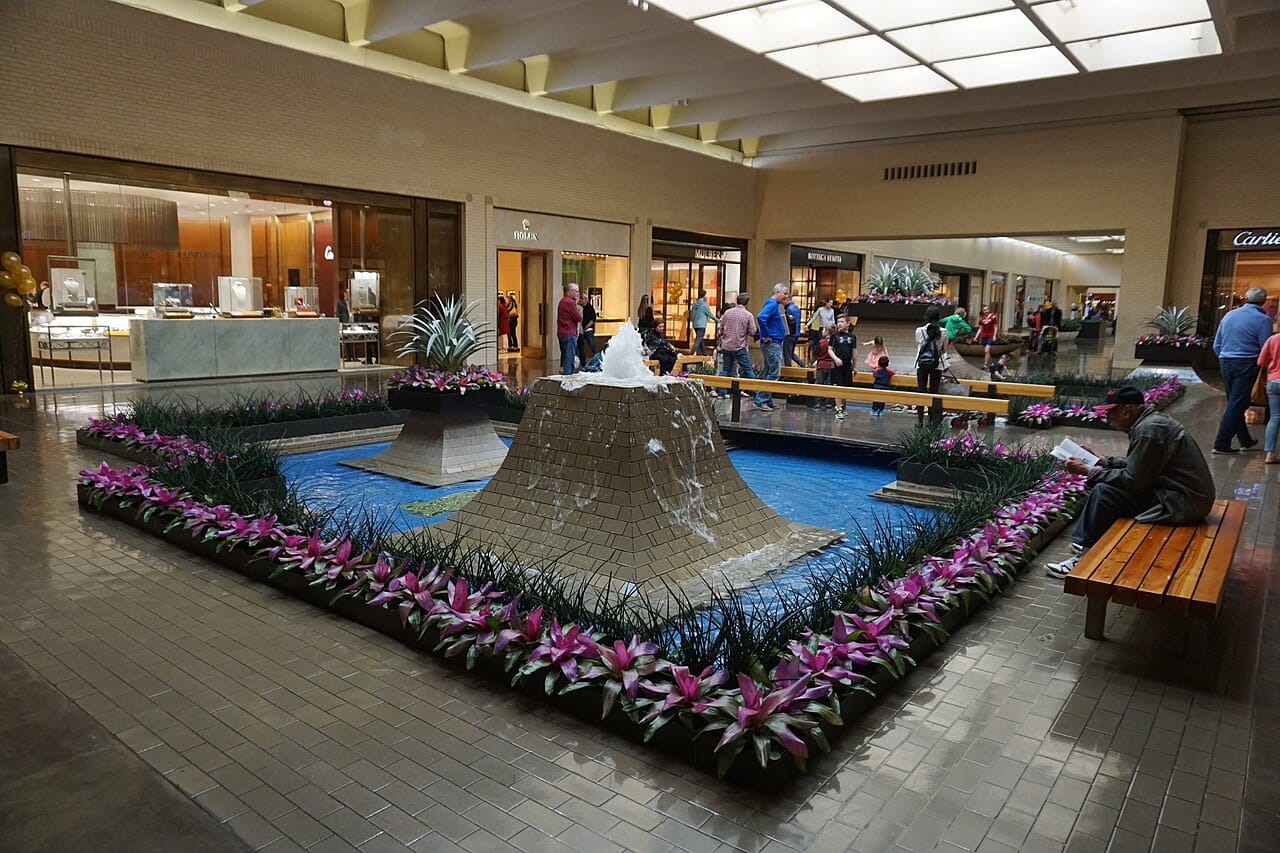
1. The floor plan was laid out with the galleries of New York’s Metropolitan Museum in mind — shifting ceiling heights, controlled daylight, a sequence of courts at different elevations.
2. The brick was made specifically for the project in Henderson, Texas, and the mortar was left deliberately rough so it would read as the same material. Ray Nasher picked white because the Taj Mahal and the U.S. Capitol are white. When he first saw the sample, according to his architect, “he thought it was terrible.”
3. There are no kiosks. NorthPark bans carts and kiosks in the concourses and gives up the revenue. “The architecture is very quiet but strong,” Nancy Nasher has said, “and it lets the stores shine.”
4. There is a public library inside — Bookmarks, a branch of the Dallas Public Library, believed to be the first children’s library in a US shopping center.
5. From 1965 to 1976 there were balloon girls, reportedly Ray Nasher’s idea after watching a kid carry one through the mall.
6. The Trains at NorthPark have raised about $22 million for Ronald McDonald House since 1987 — 1,600 feet of track and more than 700 railcars.
Come see the carts. Then go look up.
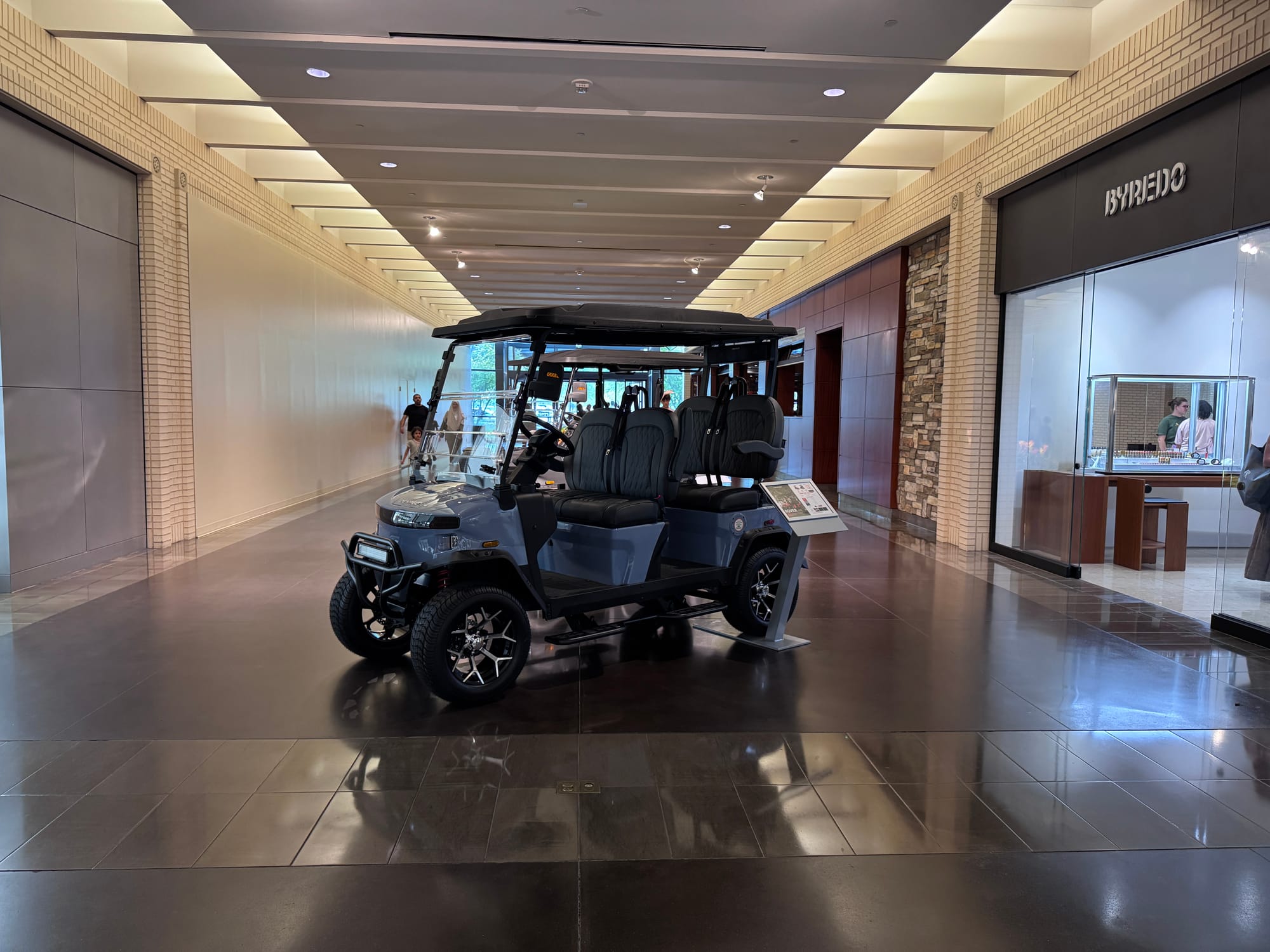
The NorthPark AutoShow 2026 runs through Sunday, August 16 — more than thirty vehicles throughout the center, during regular mall hours (Mon–Sat 10–8, Sun 12–6). Our Glacier Rover XL and Matte Black Nomad XL are on Level One outside Byredo.
We build electric golf carts and low-speed vehicles in Plano, about fifteen miles up the road. Parking a Nomad XL fifty yards from a forty-eight-foot di Suvero is not something we take for granted.
But if you only do one thing at NorthPark this month, make it this: after you have looked at the cars, walk the Level One loop all the way around. It takes about twenty-five minutes. You will also pass a Miró, two Henry Moores, two Frank Stellas, a Dubuffet, three Warhols and a KAWS. It costs nothing, and there is a Cinnabon at the end of it.
Ray Nasher was betting that if you put great art where people already are, some of it gets in. In a mall full of Bentleys and golf carts, the bet still looks good.
Plan your visit: NorthPark Center, 8687 North Central Expressway, Dallas. The full collection with an interactive map is at northparkcenter.com/art, and NorthPark runs free guided tours. The collection rotates, so check before you make a special trip.
Photographs by Payton Chung (CC BY 2.0), Michael Barera (CC BY-SA 4.0) and Frj (CC BY-SA 4.0), with thanks. Sources: NorthPark Center’s published collection catalogue; WWD; the Preston Hollow Advocate; CultureMap Dallas; and The New York Times, June 5, 2005.


